Seoul National University Hospital Develops AI to Improve Heart Rate Analysis Accuracy from Noisy Photoplethysmogram Signals
-Self-supervised AI based on blind source separation (BSS) separates heartbeat-related signals
-Reduces error and improves agreement with ECG, demonstrating applicability in real-world environments
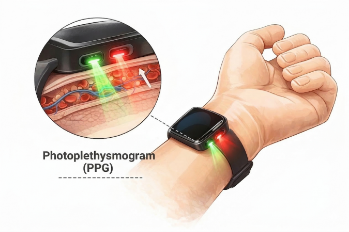
[Image] Conceptual diagram of PPG measurement. Heart rate is determined by detecting blood flow changes using light from a smartwatch. (ChatGPT-generated image)
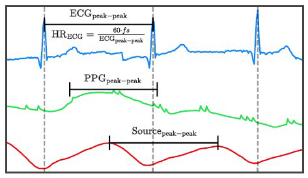
[Graph] Comparison of signals: electrocardiogram (ECG, blue), original photoplethysmogram (PPG, green), and AI-extracted source signal (red). The AI-separated signal shows clear peaks aligned with ECG-detected heartbeats.
Measuring heart rate in daily life with smartwatches or patient monitoring devices often suffers from inaccuracy during movement. This issue is particularly evident in PPG-based heart rate monitoring, widely used in wearable devices, emphasizing the need for reliable heart rate analysis methods.
A research team led by Prof. Dong-Heon Lee(Department of Radiology, Seoul National University Hospital) proposed an AI-based analysis method that isolates cardiac-related components from noisy PPG signals, enabling more accurate heart rate determination. The study demonstrated that, even in real-world conditions, separating the underlying cardiac signal from PPG data resulted in heart rate values that more closely matched those measured by electrocardiography (ECG), compared to using raw PPG signals.
PPG is a biosignal that measures heart rate by detecting changes in blood flow using light emitted onto the skin, typically at the wrist or fingertip. However, during daily activities, motion artifacts and variations in skin contact easily introduce noise, limiting the accuracy of heart rate analysis.
The research team approached noisy PPG signals not as a single imperfect signal but as a mixture of multiple physiological components. Based on this perspective, they applied the concept of blind source separation (BSS), which extracts meaningful underlying signals from mixed data, to a self-supervised learning AI model capable of learning signal structures without labeled data.
To achieve this, the research team employed a BSS-based self-supervised Multi-Encoder Autoencoder (MEAE) architecture and trained the model using photoplethysmogram (PPG) signals from the large-scale publicly available polysomnography database (MESA), without any additional noise filtering or data selection. As a result, each PPG signal was decomposed into multiple source signals, and the one exhibiting the most distinct cardiac rhythm pattern was selected for heart rate analysis.
The performance of heart rate estimation was evaluated against ECG-derived reference values, comparing raw PPG signals, conventional signal processing and separation methods, and the proposed BSS-based MEAE approach.

[Table] Comparison of heart rate analysis methods against ECG reference. The BSS-based MEAE method showed the highest agreement and the lowest error (RMSE).
As a result, in data from nine subjects (total of 108 recordings) measured from PPG containing noise during daily activities, the error (RMSE) relative to the ECG-based heart rate decreased from 14.4 ± 10.6 bpm to 4.9 ± 5.1 bpm, compared to when the PPG signal was used as is.The correlation coefficient with ECG-based heart rate also improved from 0.407 to 0.740, indicating better tracking of heart rate variations. Similar performance improvements were observed in analyses using surgical patient data.*The correlation coefficient indicates how closely two variables follow similar trends; higher values represent greater agreement with the reference signal.
This study demonstrates that it is possible to directly extract heart rate-relevant original sources from PPG data without prior knowledge of noise types or artificial noise augmentation. The findings suggest strong potential for more robust heart rate monitoring in both clinical settings and wearable medical devices.
Prof. Dongheon-Lee (Department of Radiology) stated, “In this study, we observed that not only the signals required for heart rate estimation but also other physiological rhythms, such as respiration, were separated from the cardiac signal. This shows that AI can learn structural differences in signals without prior knowledge of the correct answer.”
Meanwhile, the study was recently published in the international journal Computers in Biology and Medicine, in the field of biomedical engineering and medical informatics.

[Photo] Prof. DongHeon-Lee, Department of Radiology, Seoul National University Hospital