SNUH-Naver Unveil Korea’s Medical-Specific LLM, KMed.ai
- A medical-specific large language model(LLM) designed to support clinical workflows and advance AI-driven healthcare in Korea
- Achieved a validated score of 96.4 on the Korean Medical Licensing Examination (KMLE), laying a core foundation for Korea’s sovereign medical AI and data sovereignty
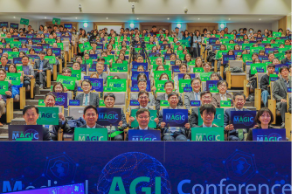
[Photo] Seoul National University Hospital and NAVER host the Medical AGI Forum
Seoul National University Hospital (SNUH) and Naver have unveiled KMed.ai, a Korean medical domain–specific large language model (LLM)jointly developed by the two institutions, marking a significant first step toward building sovereign AI in healthcare. Designed to reflect real-world clinical language and Korea’s domestic clinical standards, KMed.ai represents a sovereign AI model optimized for the Korean healthcare environment, reducing reliance on foreign general-purpose AI systems.
SNUH (President Young-Tae Kim) and Naver Corp.(CEO Soo-Yeon Choi) officially introduced KMed.ai at the Medical AGI (Artificial General Intelligence) Conferenceheld on the 28th at Seoul National University Hospital. The event was attended by key figures including Kyung-Hoon Bae, Deputy Prime Minister and Minister of Science and ICT; Hyung-Hoon Lee, Second Vice Minister of Health and Welfare; SNUH President Young-Tae Kim; Hae-Jin Lee, Chairman of Naver’s Board of Directors; and CEO Soo-Yeon Choi.
Earlier this year, in March, SNUH independently developed an initial Korean medical LLM using its own technology and conducted extensive functional validation. The newly released KMed.ai is an advanced model that integrates this early development experience and in-depth feedback from SNUH clinicians with Naver’s cutting-edge AI capabilities. Through this collaboration, the model’s clinical comprehension and accuracy were significantly enhanced, achieving an average score of 96.4 on the 2025 Korean Medical Licensing Examination (KMLE)—a result that demonstrates world-class performance in medical AI specialization.
KMed.ai was designed to reflect the structure of Korea’s healthcare system, including domestic medical laws, clinical guidelines, and care pathways. Throughout development, SNUH physicians participated directly to ensure that actual clinical language, reasoning processes, and decision-making flowsused in real-world practice were precisely incorporated. As a result, the model is recognized for its ability to accurately understand Korean medical knowledge and the contextual nuances of clinical care.
In addition, KMed.ai is positioned as a foundational model serving as the core engine for future Medical AGI development. Medical AGI refers to next-generation AI capable of sequentially understanding, reasoning, and making judgments across multiple medical tasks. KMed.ai is expected to play a central role in functions such as clinical documentation understanding, medical reasoning, and the integration of decision-making workflows.
Separately from KMed.ai, SNUH is also building a medical-specialized agent platformdesigned to help hospital staff improve efficiency through AI-assisted workflows. During the event, demonstrations included electronic medical record (EMR)–based documentation support and diagnostic assistance functions. Following the completion of required regulatory approvals, these capabilities are expected to be gradually introduced into real clinical settings. The hospital plans to continue enhancing safety and accuracy through ongoing system upgrades.
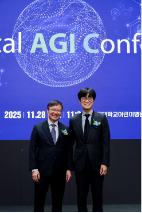
[From left] Young Tae Kim, President of Seoul National University Hospital; Hae-jin Lee, Board Chair of NAVER
In his remarks, Hae-Jin Lee, Chairman of Naver’s Board, stated,“We believe that the medical-specific LLM jointly developed by Naver and Seoul National University Hospital will safeguard critical data that must be handled with the highest standards of safety and accuracy for healthcare professionals, patients, and medical institutions alike, while also improving clinical efficiency and patient satisfaction. We hope this project becomes a successful example of a sovereign medical AI that most deeply understands Korea’s healthcare industry, clinical environments, and medical regulations.”
SNUH President Young-Tae Kimadded,“Medical AI is a national strategic technology. This achievement represents the first step and a major milestone in building Korea’s sovereign medical AI. Seoul National University Hospital will accelerate the transition to an AI-based Intelligent Hospital, enhance patient safety and quality of care, and contribute to strengthening Korea’s medical AI competitiveness and its global advancement.”
Building on the launch of KMed.ai, SNUH plans to further strengthen its AI-driven clinical support systems while maintaining a stable, patient-centered care environment. The hospital is also collaborating on the expansion of public healthcare infrastructure, including the opening of the National Firefighters Hospital, and expects to further reinforce capabilities in critical, emergency, and essential medical caregoing forward.