Optimal Duration of Dual Antiplatelet Therapy Identified for Patients at High Bleeding Risk After Coronary Stenting
- 4,897 stented patients stratified by bleeding risk; DAPT duration randomly assigned with 1-year follow-up
- In high bleeding risk patients, 3-month dual antiplatelet therapy was more effective than 1-month therapy in preventing thrombotic events
After coronary stent implantation, potent dual antiplatelet therapy (DAPT) is administered for a certain period starting immediately after the procedure to prevent stent thrombosis and restenosis. However, antiplatelet agents prescribed to prevent thrombosis inevitably increase the risk of bleeding. As a result, determining the optimal duration of DAPT has been particularly challenging in patients at high bleeding risk. A large-scale randomized clinical trial has now identified the optimal DAPT duration for this patient population.
Notably, the study demonstrated that maintaining DAPT for 3 months, rather than the conventionally considered 1 month, provided superior protection against cardiovascular events without a significant increase in bleeding risk. These findings establish a new treatment benchmark for high bleeding risk patients and were published in The Lancet (Impact Factor: 88.5).
Professor Hyo-Soo Kim of the Seoul National University Biomedical Research Institute, together with Professors Kyung Woo Park and Ji Hoon Kang from the Division of Cardiology, announced on the 13th that the results were confirmed through the HOST-BR randomized clinical trial, which enrolled 4,897 patients who underwent coronary stent implantation.
Ischaemic heart disease is caused by narrowing of the coronary arteries that supply blood to the heart. The standard treatment is percutaneous coronary intervention (PCI) using drug-eluting stents to restore vessel patency. After PCI, lifelong single antiplatelet therapy is mandatory, and during the first several months—when the risk of thrombosis is highest—two antiplatelet agents are combined as part of dual antiplatelet therapy to ensure adequate thrombotic protection.
Because DAPT is associated with bleeding complications, its duration must be individualized. Current international guidelines recommend shortening DAPT to 1–3 months in patients at high bleeding risk; however, robust evidence comparing the efficacy and safety of these durations has been limited.
* High bleeding risk (HBR) was defined according to the Academic Research Consortium for High Bleeding Risk criteria, including patients with at least one major criterion (e.g., long-term oral anticoagulation, severe or end-stage chronic kidney disease, severe anaemia, liver cirrhosis, cancer diagnosed within 1 year, or intracranial haemorrhage within 6 months) or at least two minor criteria (e.g., age ≥75 years, moderate chronic kidney disease, mild anaemia, or long-term steroid or nonsteroidal anti-inflammatory drug use).
Between 2020 and 2023, patients who underwent coronary stenting at 50 institutions across South Korea were stratified by bleeding risk. High bleeding risk patients (n=1,598) were randomly assigned to receive DAPT for 1 month or 3 months, while non–high bleeding risk patients (n=3,299) were randomly assigned to 3 months or 12 months of DAPT.
Patients were followed for 1 year after randomisation. Outcomes included thrombotic events—such as cardiovascular death, myocardial infarction, and ischaemic stroke—as well as bleeding events.
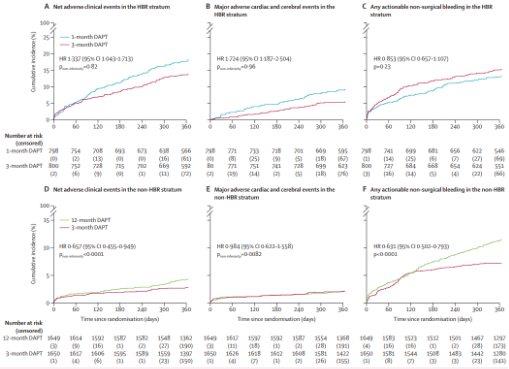
[Graph] Incidence of cardiovascular events according to bleeding risk and duration of dual antiplatelet therapy
Among patients at high bleeding risk, the 3-month DAPT group did not show a significant increase in bleeding events compared with the 1-month group, while thrombotic events were significantly reduced (5.8% vs 9.8%). Consequently, the overall incidence of net adverse clinical events was lower in the 3-month group (14.0% vs 18.4%).
In patients without high bleeding risk, 3-month DAPT did not increase thrombotic events compared with 12-month DAPT, but significantly reduced bleeding events (7.4% vs 11.7%).
In summary, 3 months of DAPT was superior to 1 month in preventing thrombotic events among high bleeding risk patients, and superior to 12 months in reducing bleeding events among non–high bleeding risk patients. Overall, regardless of bleeding risk status, 3 months was identified as the optimal duration of DAPT after coronary stenting.
Professor Kim stated, “This study is the first to validate an algorithm that determines DAPT duration based on individual bleeding risk.” He added, “Although a 1-month duration had previously been considered sufficient for high bleeding risk patients, our findings demonstrate that at least 3 months of therapy is necessary, prompting a reassessment of existing clinical assumptions.”
He further noted, “As the number of elderly patients with multiple comorbidities continues to rise, these results will be highly applicable in clinical practice. By simplifying complex treatment decisions, they are expected to improve consistency and safety in patient care. I would like to express my sincere gratitude to all collaborating investigators who contributed over five years to building this large-scale cohort, and we plan to publish additional analyses in due course.”

[Photo] Professor Hyo-Soo Kim, Seoul National University Biomedical Research Institute; Professors Kyung Woo Park and Ji Hoon Kang, Division of Cardiology