Novel MRI Marker Identified for Early Diagnosis of Knee Osteoarthritis
-Korean research team analyzed associations between MRI and X-ray findings in 1,140 patients with knee osteoarthritis
-Central femoral cartilage damage detectable only on MRI identified as a key early change in knee osteoarthritis
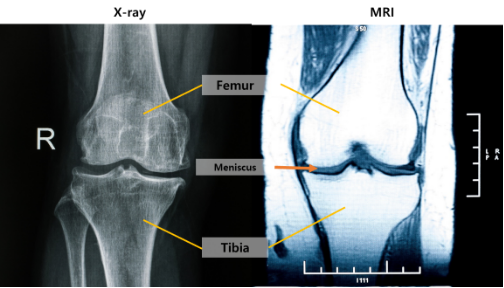
[From left] X-ray and MRI images of the knee
A Korean research team has identified a novel imaging marker that enables early detection of knee osteoarthritis (OA). The study showed that even when the knee appears normal on X-ray, the presence of central femoral cartilage damage on MRI indicates that osteoarthritic changes may already be underway. In addition, medial meniscal extrusion observed on MRI was found to be strongly associated with a high risk of disease progression.
The research was conducted by Professors Doo-Hyun Roh and Hyuk-Soo Han of the Department of Orthopaedic Surgery, Seoul National University Hospital, together with Professor Do-Won Lee of Dongguk University Ilsan Hospital. The team analyzed longitudinal MRI and X-ray data from 1,140 patients aged 50 years or older with knee osteoarthritis enrolled in the Multicenter Osteoarthritis Study (MOST) and announced the results.
Knee osteoarthritis is a degenerative joint disease caused by progressive cartilage damage and structural deterioration of joint components, affecting approximately 10–30% of the global population. Because it causes pain and functional limitation that significantly impair quality of life, early diagnosis and intervention are crucial to slowing disease progression.
In the early stages of knee OA, pathological changes occur first in soft tissues, such as articular cartilage and the meniscus. However, X-ray—the most commonly used diagnostic tool—has limited sensitivity for detecting these early changes. Although MRI allows detailed evaluation of soft tissues, its accessibility is limited, and few longitudinal studies have systematically examined the relationship between MRI and X-ray findings over time.
In this study, the researchers longitudinally followed MRI findings according to radiographic OA severity (Kellgren–Lawrence grades 0–4) for up to 7 years.
The analysis revealed that the earliest structural change in knee OA was cartilage loss in the central femoral region. Notably, this finding was already evident in Kellgren–Lawrence grade 0 knees, which are considered normal on X-ray, demonstrating that MRI is a critical tool for detecting early osteoarthritic changes.
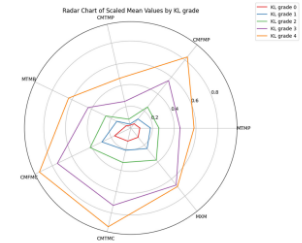
[Figure] MRI findings according to knee osteoarthritis stage. Central femoral cartilage damage was observed even in Kellgren–Lawrence grade 0 knees (red line), indicating its role as a key early feature of knee osteoarthritis.
The strongest predictor of OA progression was meniscal extrusion. Follow-up duration itself was not significantly associated with progression, indicating that structural changes in the knee, rather than time alone, primarily drive disease advancement. The pattern of tissue damage also differed by compartment: in the central compartment, damage progressed in the order of cartilage, meniscus, and bone, whereas in the posterior compartment, meniscal pathology preceded cartilage and bone changes.
The team further analyzed X-ray features associated with early MRI findings, specifically central femoral cartilage damage. They found that tibial osteophytes appeared first on X-ray, followed by medial joint space narrowing and then femoral osteophytes, all of which were significantly associated with cartilage damage.
Professor Roh (Department of Orthopaedic Surgery, SNUH) stated, “This study systematically elucidates the sequence of structural changes in knee osteoarthritis and validates key predictors of early disease.” He added, “In clinical settings where access to MRI is limited, specific X-ray findings may serve as surrogate indicators to indirectly predict the onset and progression of osteoarthritis, thereby improving the efficiency of early diagnosis.”
The study received the Best Presentation Award at the 2025 International Congress of the Korean Knee Society (ICKKS 2025) and was published in the latest issue of the international journal Knee Surgery, Sports Traumatology, Arthroscopy.

[From left] Professor Doo-Hyun Roh, Department of Orthopaedic Surgery, Seoul National University Hospital; Professor Do-Won Lee, Department of Orthopaedic Surgery, Dongguk University Ilsan Hospital