Seoul National University Hospital Selected for Four "Korean ARPA-H" Projects; Accelerating Solutions for Major Healthcare Challenges
- Participating as lead institution for two projects and a joint research partner for two others; developing core technologies such as agentic AI and ultra-precise gene therapy
- Leading projects on AI for essential medical services and hereditary retinal diseases; collaborating on research for rare genetic disease treatments and regional cancer management
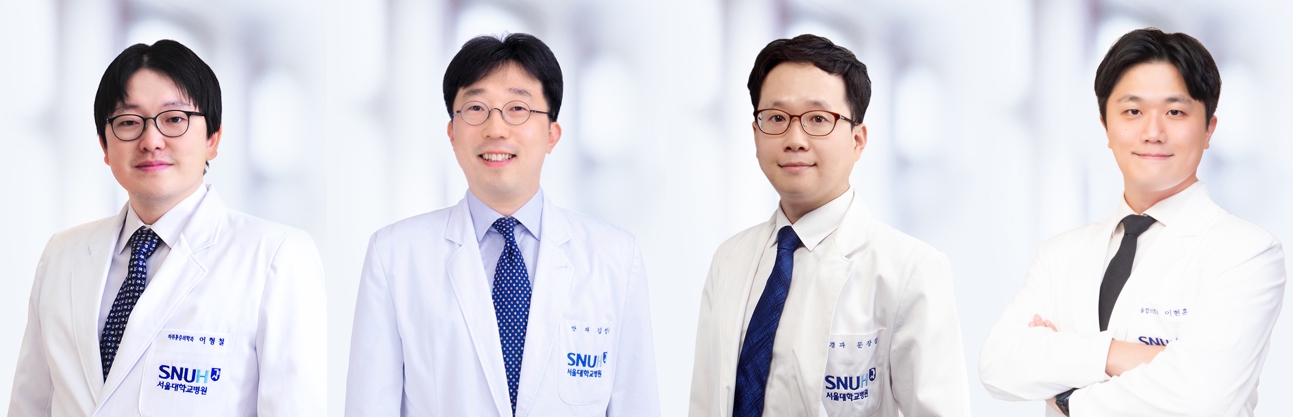
[From left] Professor Hyung-Chul Lee (Department of Anesthesiology and Pain Medicine), Professor Jeong-Hun Kim (Department of Pediatric Ophthalmology), Professor Jang-Sup Moon (Department of Genomic Medicine), and Professor Hyeon-Hoon Lee (Department of Transdisciplinary Medicine) at Seoul National University Hospital.
Seoul National University Hospital (SNUH; President and CEO Nam-Jong Paik) is launching full-scale research and development to address critical national healthcare challenges, including AI for essential medical services, ultra-precise gene therapy, rare genetic diseases, and regional cancer management. SNUH has been selected to participate in a total of four projects under the "Korean ARPA-H Project"—supported by the Ministry of Health and Welfare and the K-Health MIRAE Initiative at the Korea Health Industry Development Institute—serving as the lead institution for two projects and a joint research institution for another two.
The "Korean ARPA-H Project" is a national R&D initiative designed to support ambitious research aimed at solving healthcare challenges that are difficult to address through conventional methods. By backing high-risk, highly innovative research, the project seeks to resolve healthcare issues that significantly impact public health and quality of life.
In this project, SNUH will oversee two initiatives as the lead institution: ▲Establishing and validating an "Agentic AI" orchestration ecosystem focused on expanding regional, essential, and public healthcare services (Collaborative Healthcare Agentic AI Integration Network, CHAIN) ▲Developing an integrated ("one-loop") precision gene-editing therapy platform targeting frequent genetic variants associated with hereditary retinal diseases in Koreans. Additionally, the hospital will participate as a joint research institution in two other projects: ▲Developing "N-of-many" gene-editing therapies based on domestic clinical data from patients with genetic diseases ▲Establishing a risk-stratification model for regional cancer patients and validating a regional cancer management network (Network for Equitable CROSS-institutional Unified cancer Support, NEXUS).
First, the "CHAIN" project—an initiative in the essential medical care sector—is led by Principal Investigator Professor Hyung-Chul Lee of the Department of Anesthesiology and Pain Medicine (who also serves as Director of the Healthcare AI Research Institute). The project has a total budget of 14.65 billion KRW spanning four and a half years through the end of 2030, with the first phase allocated 3.15 billion KRW. A consortium of eight organizations has been formed, led by Seoul National University Hospital (SNUH) and including five other university hospitals—Kangwon National University Hospital, Chungnam National University Hospital, Kyungpook National University Hospital, Jeonbuk National University Hospital, and Konkuk University Hospital—alongside AI specialist companies Acryl Inc. and Infmedics Inc. The consortium recently held a kickoff meeting and has commenced full-scale research and development. The research team plans to build "KoreaHealth.ai," a medical agent platform capable of autonomously planning and executing tasks, and to validate the system at five regional responsible medical institutions.
Notably, the project will expand the architecture of "SNUH.AI"—an AI platform previously operated internally by Seoul National University Hospital—across the entire consortium. It will also implement a "Sovereign Medical AI" design, which keeps raw patient data securely within the hospital to prevent any risk of data leakage. The team aims to complete platform development and validation by the end of 2027, with plans to release and distribute a cumulative total of 1,000 validated medical agents for free by 2030.
Another key project—"Development of an Integrated Gene-Editing Precision Therapy Platform Targeting Frequent Variants of Hereditary Retinal Diseases in Koreans"—is led by a research team headed by Professor Jeong-Hun Kim (Department of Pediatric Ophthalmology). Involving institutions such as Asan Medical Center, the University of Ulsan College of Medicine, Yonsei University College of Medicine, Chungnam National University, Articure, and the Korea Research Institute of Bioscience and Biotechnology (KRIBB), the project launched in July 2026. It is scheduled to run until the end of 2030, with potential funding of up to 8 billion KRW contingent on passing interim evaluations.
The research team plans to identify specific variants within the gene groups primarily responsible for hereditary retinal diseases in Koreans. They aim to construct a map for ultra-precise therapy by using next-generation long-read whole-genome sequencing to detect structural variants that are difficult to identify via short-read analysis. Based on this, the team intends to establish preclinical evidence by validating base editing (BE) and prime editing (PE) technologies—utilizing safety-verified AAV8 vectors—in patient-derived organoids and animal models.
In addition, research teams from Seoul National University Hospital are participating as key partners in major national projects led by other institutions. For the project titled "Development of N-of-many Gene-Editing Therapeutics Based on Domestic Clinical Data of Patients with Genetic Diseases"—led by the Seoul National University Industry-Academic Cooperation Foundation, with Professor Sang-Su Bae (Seoul National University College of Medicine) and Professor Jang-Sup Moon (Department of Genomic Medicine, SNUH) serving as co-principal investigators—the team will collaborate to refine gene-editing tools applicable to multiple patients by integrating clinical data from domestic rare genetic disease patients and to establish an "rD2T" platform that rapidly links diagnosis with treatment.
Furthermore, the team led by Professor Hyeon-Hoon Lee (Department of Transdisciplinary Medicine) is participating as a joint research partner in the "NEXUS" project led by Pusan National University Hospital. They plan to collaborate on establishing a multi-institutional standard data model for cancer and a secure governance framework, as well as validating AI-based multidisciplinary team (AI-MDT) consultation models risk between regional hospitals and tertiary hospitals in the Seoul metropolitan area and early prediction models for cancer recurrence.
Nam-Jong, Paik(SNUH President and CEO) stated, "We will lead the way in core future healthcare technologies by establishing infrastructure for AI agents in essential medical services and platforms for ultra-precise gene therapy." He added, "We will also contribute to building an advanced healthcare safety net by leveraging SNUH's data and clinical expertise in the collaborative projects aimed at overcoming rare genetic diseases and establishing a regionally self-contained cancer care network."