Seoul National University Hospital and Seoul National University College of Medicine: "Causative Genes for Repeat Expansion Disorders Diagnosed in 25 Hours"
- Development of a one-stop technology based on CRISPR-Cas9 and nanopore sequencing… Simultaneous testing of 56 genetic loci
- Identified causes in 32.4% of patients with cerebellar ataxia of unknown origin… Reduced diagnostic time from the previous 2–6 months to 25 hours
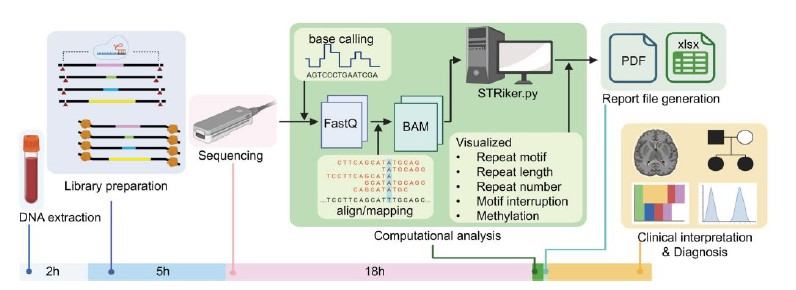
[Figure 1] nCATS-STRiker-based diagnostic workflow for repeat expansion disorders. Blood DNA is targeted and cleaved using Cas9 and sequenced via nanopore technology; STRiker then analyzes repeat sequences and methylation to generate a diagnostic report. (Total time required: 25 hours)
A new diagnostic technique has been developed that allows for the rapid identification—within just a day or two—of repeat sequence expansions in patients with cerebellar ataxia whose conditions previously lacked a known cause. A South Korean research team developed a method to simultaneously analyze 56 genes associated with genetic disorders caused by "short tandem repeat (STR) expansions" in a single test. This advancement reduces the time required to detect such genetic abnormalities to 25 hours (approximately 1–2 days).
On September 17, a joint research team—led by Professor Jang-Sup Moon of the Department of Genomic Medicine at Seoul National University Hospital and Professor Sang-Su Bae of the Department of Biochemistry and Molecular Biology at Seoul National University College of Medicine (with co-first authors Professor Seung-Bok Lee and students Chan-Ju Jung and Min-Jeong Kim)—announced the results of a study in which they applied this technique to identify the underlying causes in previously undiagnosed patients with cerebellar ataxia.
"Repeat expansion disorders" are a group of genetic diseases caused by the abnormal elongation and proliferation of specific DNA sequences, leading to abnormalities in the brain or nervous system. Cerebellar ataxia, characterized by a loss of balance, is a prime example; to date, 56 genetic loci have been identified as causes for this group of disorders, with new ones continuously being reported. A major challenge was that conventional short-read sequencing methods struggled to accurately determine the structure and repeat count of these elongated sequences. Consequently, patients faced a lengthy diagnostic journey, taking an average of 8.9 years from the onset of symptoms to receive a definitive diagnosis.
The research team optimized the "nCATS" technique, which involves selectively cutting these 56 genetic loci using CRISPR-Cas9 gene-editing tools and directly reading the long sequences via third-generation nanopore sequencing. By integrating this with "STRiker"—proprietary software designed to automatically interpret and visualize complex, expanded genetic patterns—they developed a platform capable of simultaneously and precisely analyzing all 56 loci in a single test. The test requires only 5 µg of DNA from a patient's blood sample and takes a total of 25 hours to complete, covering DNA extraction (2 hours), library preparation (5 hours), and sequencing (18 hours). Subsequent computational analysis using STRiker is completed in just a few minutes.
When the research team applied this platform to 37 patients with cerebellar ataxia—whose causes had remained unidentified even after the latest conventional genetic testing—they successfully identified the causative genes in 12 patients (32.4% of the total). Repeat sequence expansions were detected in FGF14 (4 patients), ATXN8OS, NOP56, and RFC1 (2 patients each), and PRNP and NOTCH2NLC (1 patient each). Notably, the PRNP repeat expansion marked the first such case reported in an Asian population. The cause remained unidentified for the remaining 25 patients, indicating a need for further research. The team also conducted follow-up testing on the families of the diagnosed patients, identifying the same genetic abnormalities in six relatives across five families, thereby providing opportunities for early diagnosis and genetic counseling.
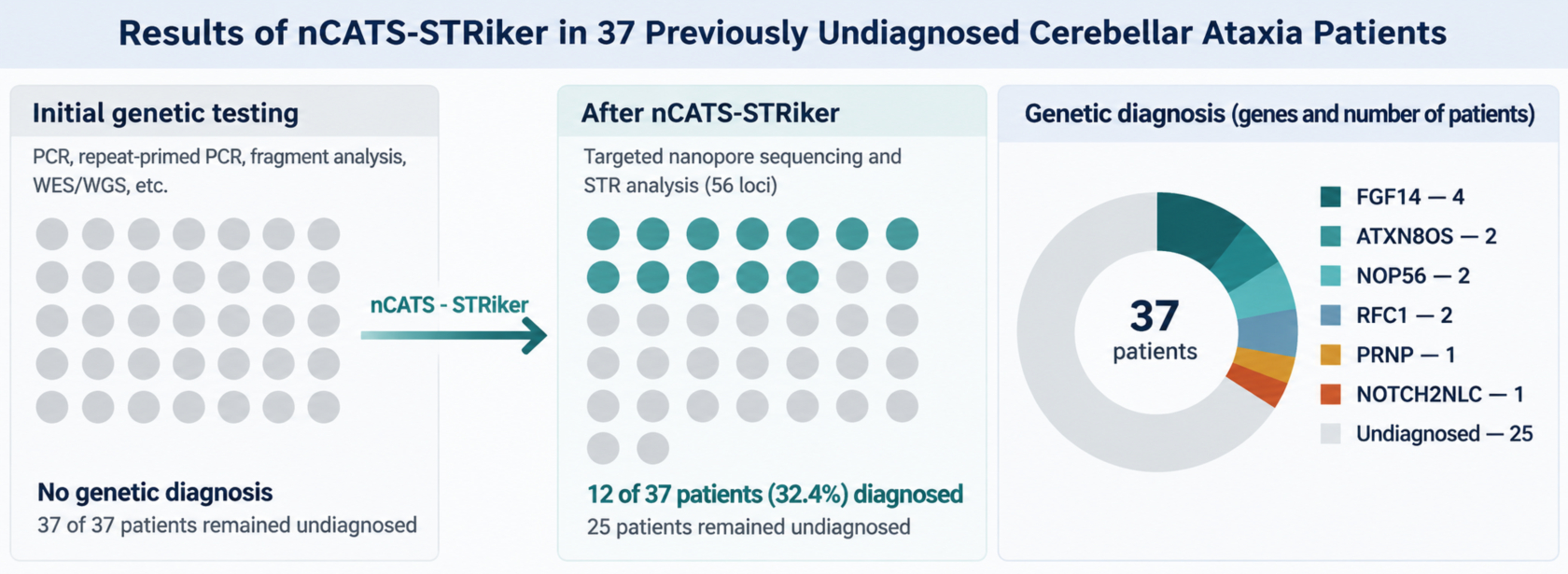
[Figure 2] Clinical application results for patients with undiagnosed cerebellar ataxia. nCATS-STRiker was applied to 37 patients with cerebellar ataxia whose underlying causes had not been identified through conventional testing, successfully identifying the causative gene in 12 patients (32.4%).
A key strength of this technology is its ability to read genes in their native form—without artificial replication or amplification—while simultaneously analyzing "DNA methylation" states, which act as switches to turn gene activity on or off. In fact, the research team analyzed two families affected by NOTCH2NLC repeat-sequence expansions; they observed that while the repeat length increased during transmission from mother to child, the level of methylation also rose, resulting in the child remaining asymptomatic. This demonstrates that for certain repeat-sequence expansion disorders, examining methylation status alongside repeat length can help elucidate the patterns of disease manifestation.
This study is significant for having identified the underlying cause in previously undiagnosed patients. It is particularly noteworthy for its potential application in diagnosing not only cerebellar ataxia but also a broader range of repeat-sequence expansion disorders.
Professor Jang-Sup Moon (Department of Genomic Medicine) stated, "This study offers new diagnostic opportunities for patients with repeat expansion disorders—such as undiagnosed cerebellar ataxia—whose conditions had previously remained unidentified despite undergoing numerous tests." He added, "We hope that this technology will enable more patients to receive rapid and accurate diagnoses without having to endure a years-long diagnostic journey."
Meanwhile, the findings of this study were published in the latest issue of the international journal Advanced Science (Impact Factor: 14.1).

[From left] Professors Jang-Sup Moon and Seung-Bok Lee (Department of Genomic Medicine, Seoul National University Hospital) and Professor Sang-Su Bae (Department of Biochemistry and Molecular Biology, Seoul National University College of Medicine).