Seoul National University Hospital and University Hospital Bonn Propose Strategy to Enhance Efficacy and Reduce Side Effects of Cancer Immunotherapy Using Nanotechnology
- Comprehensive overview of nanoparticle applications and combination strategies across six key immunotherapy areas, including CAR-T and cancer vaccines
- Outline of future development directions and challenges for clinical translation based on the latest research and clinical status
A nanotechnology strategy designed to enhance the efficacy of immunotherapy while minimizing side effects—by precisely delivering drugs to tumor sites—has been systematically outlined. This approach charts a course for next-generation, nanotechnology-based advancements aimed at overcoming the limitations of existing immunotherapies, such as low therapeutic response rates and systemic toxicity.
A research team led by Professor Sun-Ha Paek (and Dr. Un-Tack Cho) of the Department of Neurosurgery at Seoul National University Hospital—in collaboration with teams led by Professors Ingo G. H. Schmidt-Wolf and Amit Sharma at the University Hospital Bonn (Germany) and Dr. Jingjing Pu at Renji Hospital, Shanghai Jiao Tong University (China)—published a review article in the recent issue of the international journal Molecular Cancer (Impact Factor: 42.2). The paper provides a comprehensive review of the latest research and clinical status of nano-immunotherapy and proposes a multi-modal combination therapy platform.
Cancer immunotherapy is a treatment method that reactivates the body's suppressed immune cells, enabling them to directly attack cancer cells. Immune checkpoint inhibitors—which block the immunosuppressive signals emitted by cancer cells, thereby allowing immune cells to remain active—have demonstrated efficacy in cancers with high mutational burden, such as melanoma. Meanwhile, CAR-T cell therapy—which involves genetically engineering a patient's T cells to recognize cancer cells before reinfusing them—has shown particularly remarkable results in hematologic malignancies such as leukemia, fundamentally transforming the treatment paradigm over the past two decades.
However, these treatments are not effective for every patient. In many cases of solid tumors, efficacy is limited because immune cells struggle to penetrate the tumor; furthermore, the nature of the treatment—which stimulates the immune system throughout the body—can lead to immune-related systemic side effects such as colitis and pneumonitis. The research team turned to nanotechnology as a solution to overcome these limitations. Because the size and surface properties of nanoparticles can be precisely controlled, they enable the accurate delivery of therapeutic agents specifically to the tumor site and allow for control over the timing of their release.
The team reviewed the current status of nanotechnology applications across six key areas of cancer immunotherapy—▲Immune checkpoint inhibitors ▲Cancer vaccines ▲CAR-T cell therapy ▲CIK cell therapy ▲Cytokine delivery ▲Complement-based immunotherapy—and proposed combination strategies that integrate various therapeutic mechanisms.
In the field of personalized mRNA cancer vaccines, the team highlighted how lipid nanoparticles (LNPs) can efficiently deliver mRNA—encoded with information on tumor-specific antigens (neoantigens) identified from a patient's own cancer cells—to elicit a potent T-cell immune response. Regarding CAR-T cell therapy, they introduced a technology for in vivo CAR-T cell generation: using nanoparticles to deliver CAR genes directly to T cells within the body, in contrast to conventional methods that require ex vivo cell culture and manipulation. They predicted that if this technology is commercialized, it could significantly reduce manufacturing costs and time, thereby improving patient access to treatment.
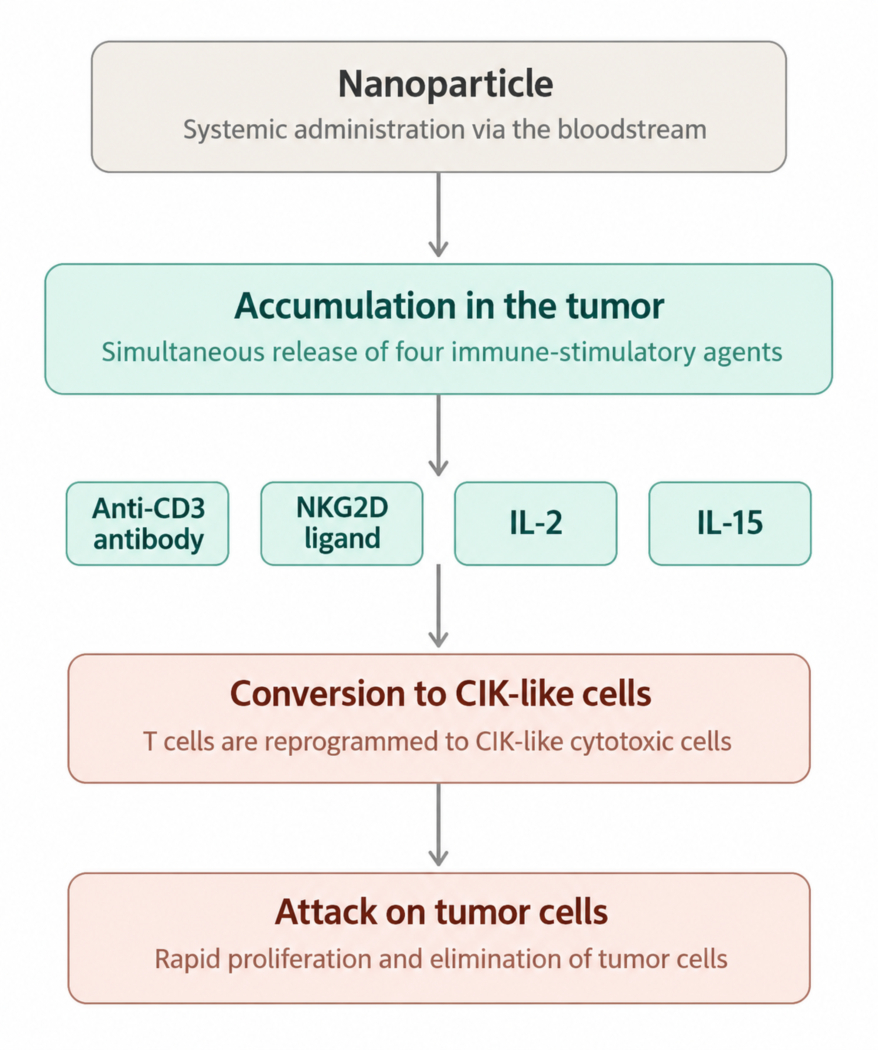
[Figure 1] Nanoparticle delivery strategy for CIK cell therapy. Mechanism for inducing a CIK-like immune response by delivering four types of immunostimulatory agents to the tumor microenvironment.
In particular, the research team proposed a novel conceptual nanoparticle strategy in this review paper to overcome the limitations of CIK (cytokine-induced killer) cell therapy. While CIK cells possess characteristics of both T cells and NK cells—enabling them to broadly target various cancer cells with a favorable safety profile—their therapeutic efficacy has been hampered by poor tumor-homing ability and limited persistence in the body, stemming from the requirement for ex vivo (outside the body) cultivation and subsequent re-infusion.
The team introduced a concept for delivering four immune-stimulating agents—anti-CD3 antibody, NKG2D ligand, IL-2, and IL-15—encapsulated within a single nanoparticle. The strategy involves the nanoparticles accumulating at the tumor site via the tumor's abnormal vascular structure (the enhanced permeability and retention, or EPR, effect) and subsequently releasing the stimulating agents simultaneously; this induces T cells within the tumor microenvironment to acquire CIK-like characteristics. While this approach demonstrates the potential to elicit a precise immune response in vivo without complex ex vivo cultivation, its feasibility for actual clinical application remains to be validated through further research.
Additionally, the team proposed two combination strategies that integrate distinct therapeutic mechanisms into a single nanoparticle. One such strategy utilizes nanoparticles encapsulating both a tumor-targeting marker (tumor antigen) and an immune checkpoint inhibitor antibody; in the acidic environment of the tumor (pH 6.5–6.8), the nanoparticle's shell spontaneously disassembles, simultaneously releasing both agents to activate T cells while blocking inhibitory signals.
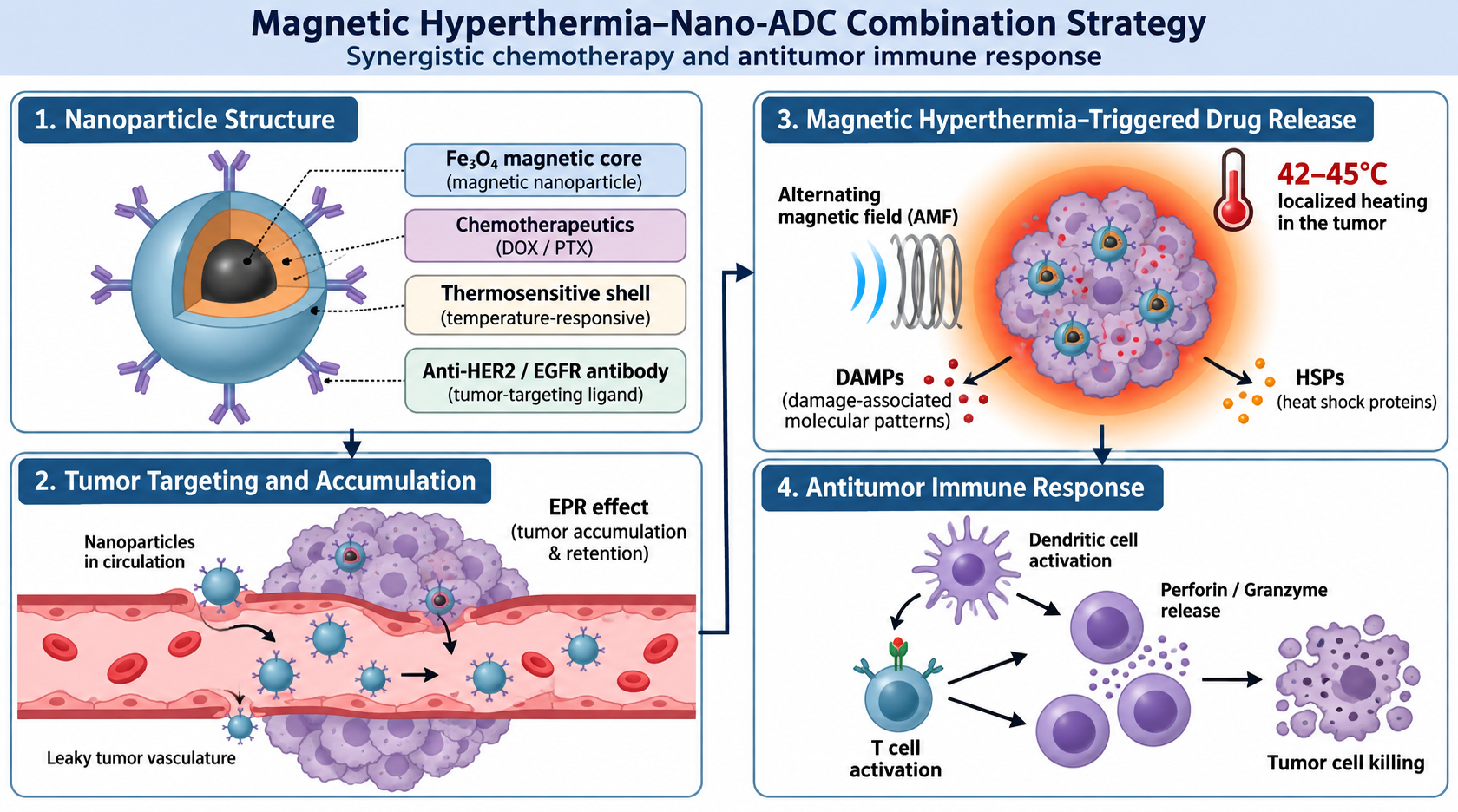
[Figure 2] Mechanism of action for the combination therapy of magnetic hyperthermia and nano-ADCs. The principle involves simultaneously inducing drug release and an anti-cancer immune response through external magnetic field stimulation (42–45°C).
Another approach involves a nanoparticle strategy that combines magnetic iron oxide particles with anticancer drugs (such as doxorubicin and paclitaxel) and tumor-targeting antibodies. This dual-action mechanism is designed to trigger drug release by generating localized heat (42–45°C) at the tumor site via an external alternating magnetic field, while simultaneously inducing an immune response through signaling molecules (such as DAMPs and HSPs) generated by the thermal stimulation.
The study also outlined future directions, including AI-guided nanoparticle design, nanoparticles capable of crossing the blood-brain barrier (BBB), and integration with gene-editing (CRISPR) and microbiome-modulating technologies. Additionally, it highlighted challenges that must be addressed for clinical translation, such as standardizing large-scale manufacturing and establishing safety assessment frameworks.
Professor Sun-Ha Paek (Department of Neurosurgery, Seoul National University Hospital) stated, "Nanotechnology is an innovative platform capable of enhancing delivery precision and reducing side effects in cancer immunotherapy; it is poised to become a core technology for realizing patient-specific precision medicine." He added, "I hope this review article serves as a practical reference for the development and clinical application of next-generation cancer immunotherapies."

[From left] Professors Sun-Ha Paek and Dr. Un-Tack Cho (Department of Neurosurgery, Seoul National University Hospital); Professors Ingo G. H. Schmidt-Wolf and Amit Sharma (University Hospital Bonn, Germany); and Dr. Jingjing Fu (Renji Hospital, Shanghai Jiao Tong University, China).