Pediatric Optic Neuritis: Most Patients Recover Vision After 6 Months Despite Significant Initial Loss
- Joint study by 31 medical institutions, including Seoul National University Hospital; Korea's first prospective multicenter cohort study
- 78.9% of patients with initially low vision recovered "good vision" (visual acuity ≥ 0.5); 8 out of 10 showed a favorable prognosis
- Positivity rate for the causative antibody (MOG) was 70.5%, significantly higher than in Western populations (54%); study identifies characteristics of Asian pediatric patients
A study has shown that while pediatric optic neuritis—a condition causing sudden vision loss in children—can lead to severe visual impairment at onset, most patients recover to a satisfactory level of vision within six months of treatment.
On September 4, a research team led by Professors Seong-Joon Kim, Jae Ho Jung, and Hye Jun Joo of the Department of Ophthalmology at Seoul National University Hospital announced the findings of a prospective multicenter cohort study conducted in collaboration with 31 hospitals across Korea. The study identified unique immunological characteristics in Asian pediatric patients: an overwhelmingly higher prevalence of the myelin oligodendrocyte glycoprotein (MOG) antibody—a causative factor—compared with Western children, and a complete absence of the aquaporin-4 (AQP4) antibody.
Optic neuritis is a condition characterized by a rapid decline in vision due to inflammation of the optic nerve, which transmits visual information to the brain. Because the prevalence of pediatric optic neuritis is very low, the condition is little known to the public, and prospective studies on it are rare. Previously, understanding the specific clinical characteristics of Asian patients was difficult because reliance was placed primarily on North American studies conducted by the Pediatric Eye Disease Investigator Group (PEDIG), which involved predominantly Caucasian populations and low rates of antibody testing.
To characterize the condition in domestic pediatric patients, the research team conducted the Korea-Pediatric Optic Neuritis Study (K-PONS), a multicenter cohort study involving 31 referral medical centers across the country, from January 2023 to December 2024. The study enrolled 44 pediatric patients under 18 years of age presenting with a first episode of optic neuritis; they underwent detailed visual acuity testing, screening for causative antibodies, and MRI scans, and were monitored for six months following treatment to assess their prognosis.
To objectively compare visual outcomes, the team categorized best-corrected visual acuity (BCVA) into three levels: ▲High vision (BCVA ≥ 20/40) ▲Moderate vision (20/200 < BCVA < 20/40) ▲Low vision (BCVA ≤ 20/200). All 44 patients were treated with high-dose intravenous methylprednisolone (IVMP), followed by a tapering regimen of oral steroids.
*High vision (visual acuity ≥ 0.5), moderate vision (0.1 < visual acuity < 0.5), low vision (visual acuity ≤ 0.1)
More than half (56.8%) of the participating pediatric patients (mean age, 10.7 years) had bilateral optic neuritis, affecting both eyes, and the majority (81.8%) presented with optic disc swelling. Detailed antibody testing revealed that 7 out of 10 patients (70.5%) tested positive for the MOG antibody, identifying it as the most common cause of pediatric optic neuritis. In contrast, no patients tested positive for the AQP4 antibody, a major cause of neuromyelitis optica spectrum disorder (NMOSD). Myelin oligodendrocyte glycoprotein antibody–associated disease (MOGAD) accounted for the majority of final diagnoses (68.2%).
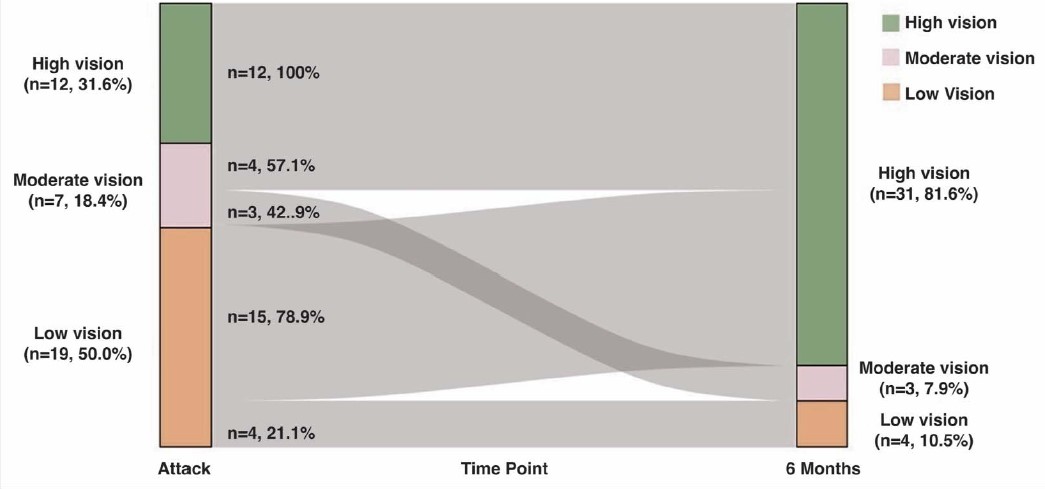
[Figure] Visual outcomes in pediatric optic neuritis patients (based on 38 patients who completed 6-month follow-up). Of the 19 patients who initially had low vision, 15 (78.9%) recovered high vision after six months.
Visual recovery among the pediatric patients was favorable following treatment. Mean visual acuity improved significantly from 0.99 logMAR at onset to 0.24 logMAR after six months (lower values indicate better vision).
An analysis of the 38 patients who completed the six-month follow-up revealed that while half (19 patients) had low vision at onset, the number of patients with high vision rose sharply to 31 (81.6%)—more than 8 in 10—by the six-month mark. Half of the patients showed improvement in their visual category, while the other half maintained their initial status; no cases of deterioration were observed. Notably, 15 of the 19 patients (78.9%) who initially had severe low vision ultimately recovered high vision.
No statistically significant associations were found between the final visual outcome and factors such as sex, age, presence of pain or optic disc swelling, severity of initial vision loss, MOG antibody status, or MRI abnormalities.
Compared with the North American PEDIG study, these findings highlight immunological characteristics distinguishing Asian pediatric patients from their Western counterparts: the MOG antibody positivity rate was higher in Korean pediatric patients (70.5% vs. 54% in North America), and there were no cases of AQP4 antibody positivity. Although no recurrences occurred during the initial six-month observation period, recurrences were confirmed in 4 of 16 patients (25.0%) followed up for one year, indicating a need for long-term monitoring.
The research team expects that this study will serve as important baseline data for developing tailored treatment strategies for pediatric patients with optic neuritis.
Professor Seong-Joon Kim (Department of Pediatric Ophthalmology) stated, "While parents are often deeply concerned about pediatric optic neuritis due to severe initial vision loss, we confirmed that these patients show excellent recovery following treatment, and that—unlike in Western populations—MOG antibody positivity is overwhelmingly prevalent." He added, "We hope this study will provide the basis for developing tailored treatment guidelines for Asian pediatric patients in the future.“
This study was supported by the SNUH Lee Kun-hee Child Cancer and Rare Disease Project and was published in the latest issue of the Journal of Neuro-Ophthalmology.
![그림입니다. 원본 그림의 이름: [사진 왼쪽부터] 서울대병원 소아안과 김성준·정재호·주혜준 교수.jpg 원본 그림의 크기: 가로 1196pixel, 세로 550pixel](https://www.snuh.org/upload/editor/images/000117/20260914140459537_ZCGGW3FB.jpg "external_image")
[From left] Professors Seong-Joon Kim, Jae-ho Jung, and Hye-Jun Joo of the Department of Pediatric Ophthalmology at Seoul National University Hospital.